
The Founding of the BSA

| - Daniel Carter Beard 1850-1941 - Continued - |
Beard wrote that he became interested in
youth after attending a business meeting one cold, snowy day. With
great difficulty he made his way through a storm to where the
meeting was held. Outside he saw half a dozen newsboys huddled
together improperly clothed, shivering in the cold. After the
meeting when he existed the building they were still there just as
cold and even more pitiful than before. He thought on his carefree
childhood of comfort and leisure and decided that he might do
something for youth. His first book for boys was
The American Boys
Handy Book published in 1882. It’s curious that his next book for
boys wasn’t until 1907, at which time he wrote
Jack of All Trades,
Dan Beards Animal Book and
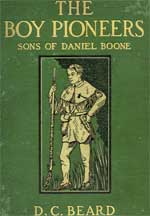
The Boy Pioneers (Sons of Daniel Boone)
in 1909. It’s possible that Beards interest was awaken by the fact
that others were prolifically publishing books for boys in these
years.
The book is based on the hero’s of Beards childhood in Kentucky.
Daniel Boone, Davy Crockett, Simon Kenton, Kit Carson, and Johnny
Appleseed. All except Johnny Appleseed were Indian fighters. There
is a chapter on Indian Sign Language but it does not appear that
Beard was enthralled with Native Americans in the way others of his
era were. When Beard was a youth in Kentucky the Indian Wars were
fresh in peoples minds. Beards parent would remember the Battle of
Fallen Timbers and the Treaty of Greenville. His grandparents would
know that the Shawnee indiscriminately killed the game outside
Marietta to starve the pioneers and would remember the massacre at
Big Bottoms.
It’s unknown to what extent The Sons of Daniel Boone grew. Beard
wrote that there were forty forts across the breadth of the USA. 32
boys in a fort x 40 is 1260 boys. Elsewhere it’s claimed that 20,000
boys wear the button of the SDM. Beards 1909 book was two years
behind Seton’s Woodcraft Indians
and a year after Baden Powell’s, Scouting
for Boys. A costume is described and how to make it. Each boy
held a position and the book had patterns that could be copied and
cut from felt or cloth. With the BSA forming in 1910 Beard merged
his group. Beard later claimed he lost a substantial sum of money by
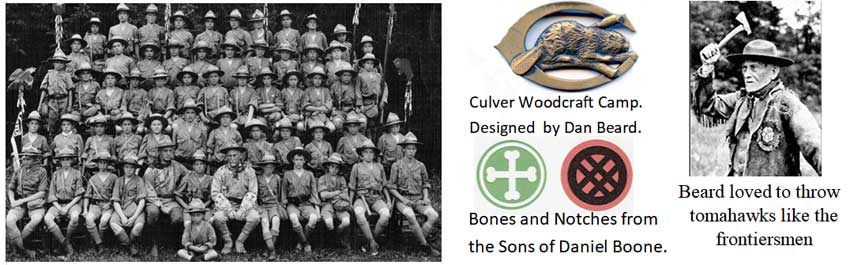
consolidating with the BSA. His group had no dues In 1919, The YMCA published an outdoor book, Handbook for Pioneers. It was “A program of Christian Citizenship Training for Boys Twelve to Fourteen Years of Age”. It’s 411 pages and similar to a Boy Scout Handbook. The YMCA Pioneer book has nothing to do with Dan Beards, Boy Pioneers/Son’s of Daniel Boone. I’ve covered the YMCA program in a separate section. It’s interesting to note that Seton was a favorite of the YMCA but when they developed their own manual it was loaded with citizenship. Beard was an avid outdoorsman, but his experience was camping, hunting or fishing with men of his acquaintance often from the Campfire Club. He had little experience working with boys. He met Col. Gignalliat of the Culver Military Academy on the newly formed BSA Executive Board. Culver had a nautical summer camp but wanted a camp for younger boys, based along Scouting principals. Beard became the Director of “Woodcraft Camp” at Culver, 1912-1915. The program was a mixture of Boy Scouting and Beard’s Sons of Daniel Boone. Beard claimed to designed the uniforms, but his design, a frontiersman style outfit, was rejected. His S of D B insignia was used. Beard enjoyed his experience at Culver and he was well paid by the Woodcraft Camp. |
 |
 outdoorsmen's magazine. Articles included; The Famous Coyote
Hunt of Weld County (Colorado), A Haul from the Herring Pond,
Cruising for Crocodile, The Beaver as a Builder, etc. It was about
this time that Beard started developing his “how to” books for boys.
The magazine closed but Beard took the idea of the group to Women’s
Home Companion magazine. Beard had difficulty with the new editor
and left. It seems that WHC retained the rights to the name Son’s of
Daniel Boone. In 1909 Beard changed the name to Boy Pioneers and
published a handbook under the auspices of the Pictorial Review. It
was stated in the forward that The Pictorial Review, at the present
writing, is the official organ of the authors club for boys.
outdoorsmen's magazine. Articles included; The Famous Coyote
Hunt of Weld County (Colorado), A Haul from the Herring Pond,
Cruising for Crocodile, The Beaver as a Builder, etc. It was about
this time that Beard started developing his “how to” books for boys.
The magazine closed but Beard took the idea of the group to Women’s
Home Companion magazine. Beard had difficulty with the new editor
and left. It seems that WHC retained the rights to the name Son’s of
Daniel Boone. In 1909 Beard changed the name to Boy Pioneers and
published a handbook under the auspices of the Pictorial Review. It
was stated in the forward that The Pictorial Review, at the present
writing, is the official organ of the authors club for boys. 
 and only sold a small button, without membership numbers its
impossible to know. It’s difficult to judge the appeal of the Boy
Pioneers. In many areas boys carrying a Bowie knife or a tomahawk in
their belt might be frowned on. I cover the Sons of Daniel Boone on
other pages.
and only sold a small button, without membership numbers its
impossible to know. It’s difficult to judge the appeal of the Boy
Pioneers. In many areas boys carrying a Bowie knife or a tomahawk in
their belt might be frowned on. I cover the Sons of Daniel Boone on
other pages.
| Culver Woodcraft campers about 1912.
Dan Beard in buckskin in the center. The camp uniform was a wool,
short sleeve, V neck shirt, no collar and shorts. A neckerchief was
added about 1913. The BSA would issue a neckerchief in 1914. The BSA
adopted a short sleeve, v neck uniform in 1924. Writing in Boys Life (10/1915) Beard told of the splendid eight week session just completed at Culver. One hundred forty boys were turned into Scouts. In 1916 Beard left Culver to start his own camp, the Dan Beard Outdoor School for Boys, opened in 1916 and operated through at least 1922. This ended his friendship with Col. Gignilliat. Gignilliat claimed that Beard had copied things he saw and learned at Culver. Culver was (is) a prestigious private school and camp. Gignilliat worried that Beard’s camp might cut into Culver Woodcraft Camps enrollment. Gignilliat was especially upset when Beard placed an ad for his camp directly below a Culver ad, in the March 1916 issue of Boys Life. The Culver ad had run for several years. Beard ultimately closed his camps while Culver celebrated it’s 100 anniversary. There is correspondence in which Beard demurs to Gignilliat that he needed to make a living. This episode seems to fit a pattern. Beard was late coming to the youth movement even though he saw the freezing newsboys in 1888. Beard claims he was asked to write the new Boy Scout Handbook but had to decline because he needed income (this claim is unsubstantiated). Seton proudly admitted that he was a thrifty Scotsman always seeking to make a profit, but it seems that Beard was also motivated by money. Beard was a longtime member of the BSA Executive Board. Board Members were successful people and it was expected that they paid their travel expenses in connection with Scouting. Beard did not pay his expenses, they were submitted to and paid by the BSA. In Rowan’s biography of James E West, To Do My Best, he lists occasions where Dan Beard was a divisive force in the BSA. It wasn’t just disagreements on policy matters, but petty and foolish things. Beard claims Mark Twain (Samuel Clemens) as one of his best friends. Despite being a successful author and lecturer, Clemens had money difficulties all his life. It seems that he was a terrible businessman and investor. Everything he invested in resulted in catastrophe. In old age Twain was forced to take a worldwide lecture tour to pay off creditors. There are no records of Dan Beards financial situation. Like Mark Twain he had been successful, but Beard always seemed to need money. I can’t help but wonder if he took Mark Twains investment advise. |
|
| - A brief review of The Woodcraft Indians - | |
I have repeatedly heard that Baden Powell copied material from
Beard and Seton but I don’t believe anyone has actually studied
their early publications to see if there are similarities. It’s one thing to
publish articles in magazines; Recreation, Ladies Home Journal,
Women's Home Companion or the Pictorial Review, but quite another to
have an actual handbook with an organization planned for growth.
publications to see if there are similarities. It’s one thing to
publish articles in magazines; Recreation, Ladies Home Journal,
Women's Home Companion or the Pictorial Review, but quite another to
have an actual handbook with an organization planned for growth.
 The Birchbark Roll of Woodcraft Indians.
1906 printing, Double Day, Page and Company publisher. It’s a small
book, sixty six pages with five pages of advertisement for Seton’s
other books and a list of other books for nature study. The
object of this organization are the promotion of Out of Doors Life
and Woodcraft, the preservation of Wild Life and Landscape, and the
promotion of good fellowship among it’s members. Seton states
on page 4 that two important ideas underline the scheme:
Personal decoration for personal achievement; secondly no
competitive honors. Organization, get a band together any
number from 10-15 up to 50 with at least one experienced adult. The Birchbark Roll of Woodcraft Indians.
1906 printing, Double Day, Page and Company publisher. It’s a small
book, sixty six pages with five pages of advertisement for Seton’s
other books and a list of other books for nature study. The
object of this organization are the promotion of Out of Doors Life
and Woodcraft, the preservation of Wild Life and Landscape, and the
promotion of good fellowship among it’s members. Seton states
on page 4 that two important ideas underline the scheme:
Personal decoration for personal achievement; secondly no
competitive honors. Organization, get a band together any
number from 10-15 up to 50 with at least one experienced adult.
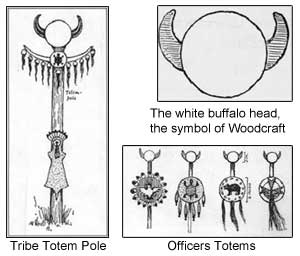
A complicated Constitution of nine articles is described. Boys must be over age 8 to be eligible. Application for membership must be made in writing. Meetings should be monthly on Monday night. It is a lot of organization. The tribe must develop a totem pole onto which emblems will be posted. Each boy aims at winning an Indian name, there are badges and awards to be earned. Each boy hoped to earn a scalp, of horse hair, which he wore on his belt. There are honors in subjects like Athletics, Nature Study, Geology, Photography, etc. Only 18 pages had illustrations. It seems to have been written more for adults than youth. |
|
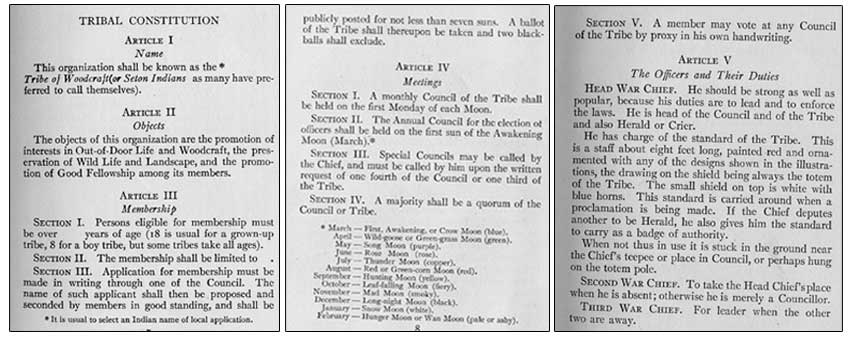 Articles one through five of a rather complicated nine point constitution |
|
| Historic researchers note: You must have
the 1906 Birchbark Rolls for the purpose of considering if Baden
Powell copied anything from Ernest Thompson Seton, or to investigate
what the 1906 original Woodcraft concept was. After Seton left
Scouting, he developed a large 441 page book, The Woodcraft Manual
in 1917, it’s a real outdoor handbook, nicely illustrated. The 1917
edition has nothing on citizenship or patriotism. It’s believed that
Seton developed this book for the YMCA or other groups that wanted
to incorporate an outdoor program within the framework of their
organization. But most youth organizations in this era were
patriotic, not having anything on citizenship would be noticed. In
1919 the YMCA developed a Handbook for Pioneers which has seventeen
pages on citizenship. |
|
| - A brief review of the Boy Pioneers - | |
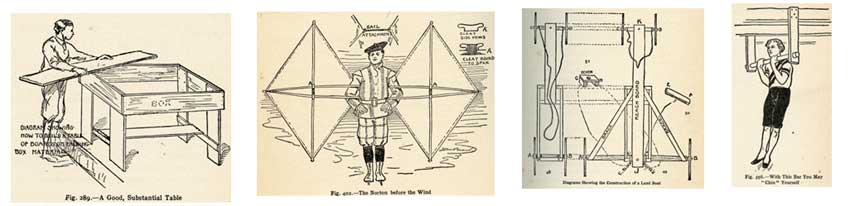
 The
Boy Pioneers/Sons of Daniel Boone 1909 Printing, Charles Scribner &
Sons, NYC 329 pages, 4 pages in the back advertising Beard’s other
books. A big thick book, written for boys. It’s heavily illustrated
with drawings and how to tips on many pages. Many of the how to
topics, how to build a bob (sled), how to make snowshoes, etc. are
from Beard’s, Boys Handy Book. Boys are organized into Stockades (8
boys) and Forts, a group in 4 stockades. The ideal size of an
individual stockade would be about 32 boys. Instructions are
provided on how to make frontiersmen costumes and emblems. The
Boy Pioneers/Sons of Daniel Boone 1909 Printing, Charles Scribner &
Sons, NYC 329 pages, 4 pages in the back advertising Beard’s other
books. A big thick book, written for boys. It’s heavily illustrated
with drawings and how to tips on many pages. Many of the how to
topics, how to build a bob (sled), how to make snowshoes, etc. are
from Beard’s, Boys Handy Book. Boys are organized into Stockades (8
boys) and Forts, a group in 4 stockades. The ideal size of an
individual stockade would be about 32 boys. Instructions are
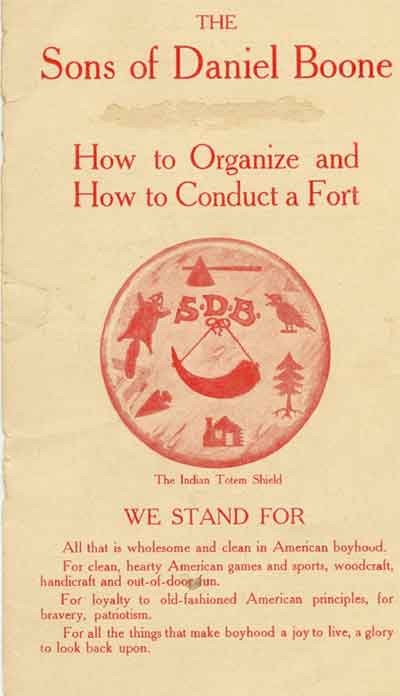
provided on how to make frontiersmen costumes and emblems.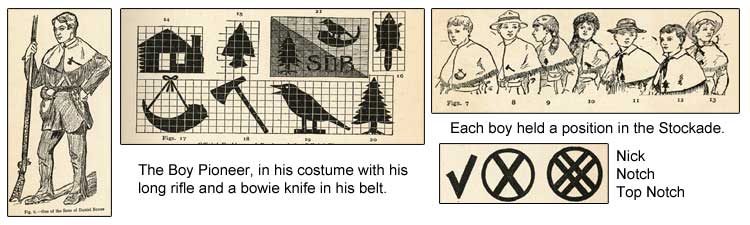 The Boy Pioneers/Sons of Daniel Boone is based on the hero’s of Beards childhood in Kentucky. Daniel Boone, Davy Crockett, Simon Kenton, Kit Carson, and Johnny Appleseed. The book states that they stand for: All that is wholesome and clean in American boyhood. For clean healthy American games and sport, woodcraft, handicraft and out of doors. For loyalty to old fashioned American principals for bravery and patriotism. For all the things that make boyhood joy to live, a glory to look back upon. All except Johnny Appleseed were Indian fighters. The word American is repeated in this and all books written by Beard. It seems as though the book is written for Americans and Beard could care less if boys from other countries or backgrounds are interested. Aside for a section on Indian Sign Language the Native American plays no part in Beards scheme for boys. Seton seems to romanticize the noble red man while Beard has nothing to say about them. The frontiersmen are the hero's, taming the wild country, wrestling it from the natives. Beard received endorsements from prominent men of the day. Theodore Roosevelt, Admiral Dewey, Maj, General Bell, and John Muir. He recognized that well known men endorsing the group would be a benefit, for publicity and to help gain acceptance with youth and their parents. I see nothing in the Sons of Daniel Boone that would have been of benefit to Baden Powell designing a group for English and Commonwealth Country scouts. Beards book was published after BP had published Scouting for Boys. For Beard to claim that Baden Powell had taken some of his ideas about a youth group and incorporated them into Scouting, under careful investigation is preposterous. |
|
 |
|
 |
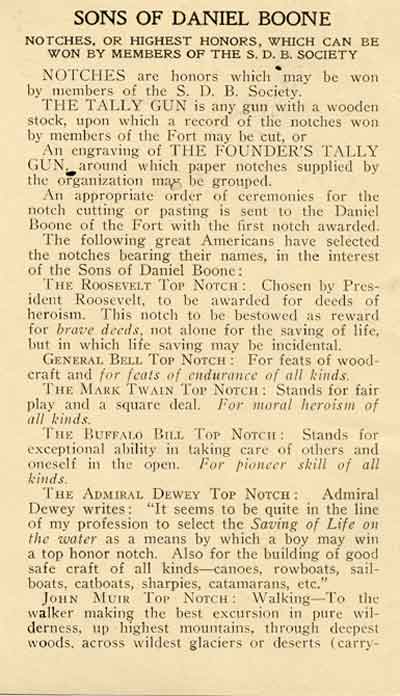 |
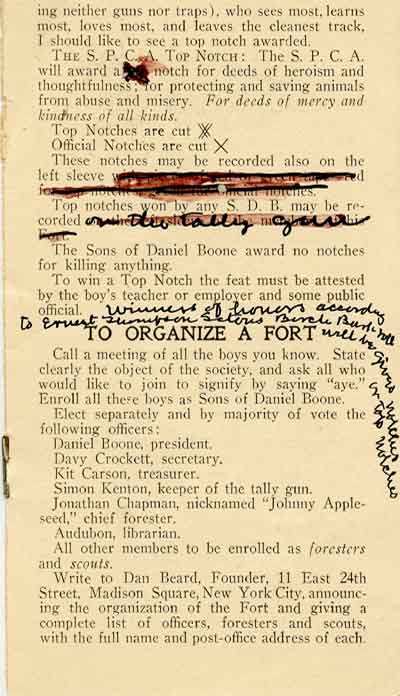
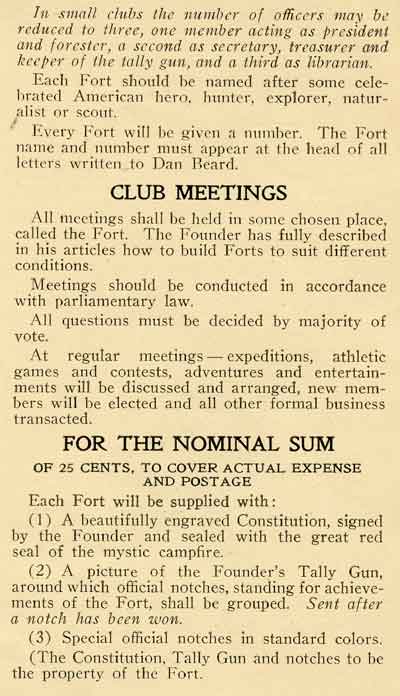
| Sons of Daniel Boone organizational 8 page flier pre-1908. Corrections believed to have been made by Dan Beard | |
 |
 |
|
|
|
| Paul Myers Goshen,
Indiana gimogash@comcast.net |
|